Accessory functions to spatially transform a normalized
GraphSpace object. cropGraphSpace() subsets the plotting
area to a rectangular region; rotateGraphSpace() rotates by a
quarter turn; flipGraphSpace() mirrors horizontally or vertically;
transposeGraphSpace() swaps the x and y axes.
Usage
# S4 method for class 'GraphSpace'
cropGraphSpace(gs, xmin = 0, xmax = 1, ymin = 0, ymax = 1, verbose = TRUE)

# S4 method for class 'GraphSpace'
flipGraphSpace(gs, vertical = TRUE, persist = .is_raw(gs), verbose = TRUE)

# S4 method for class 'GraphSpace'
rotateGraphSpace(gs, clockwise = TRUE, persist = .is_raw(gs), verbose = TRUE)

# S4 method for class 'GraphSpace'
transposeGraphSpace(gs, persist = .is_raw(gs), verbose = TRUE)
Arguments
- gs
A normalized
GraphSpaceobject.- xmin
A single number in
[0,1]specifying the lower x-boundary of the plotting area.- xmax
A single number in
[0,1]specifying the upper x-boundary of the plotting area.- ymin
A single number in
[0,1]specifying the lower y-boundary of the plotting area.- ymax
A single number in
[0,1]specifying the upper y-boundary of the plotting area.- verbose
A single logical value specifying to display detailed messages (when
verbose=TRUE) or not (whenverbose=FALSE).- vertical
Logical; if
TRUE(default), the flip is vertical (mirror top-bottom); ifTRUE, horizontal (mirror left-right). (flipGraphSpaceonly).- persist
Logical; whether the transformation persists through re-normalization. Defaults to
TRUEbefore normalization,FALSEafter.- clockwise
Logical; if
TRUE(default), the 90-degree turn is clockwise; ifTRUE, counter-clockwise (rotateGraphSpaceonly).
Details
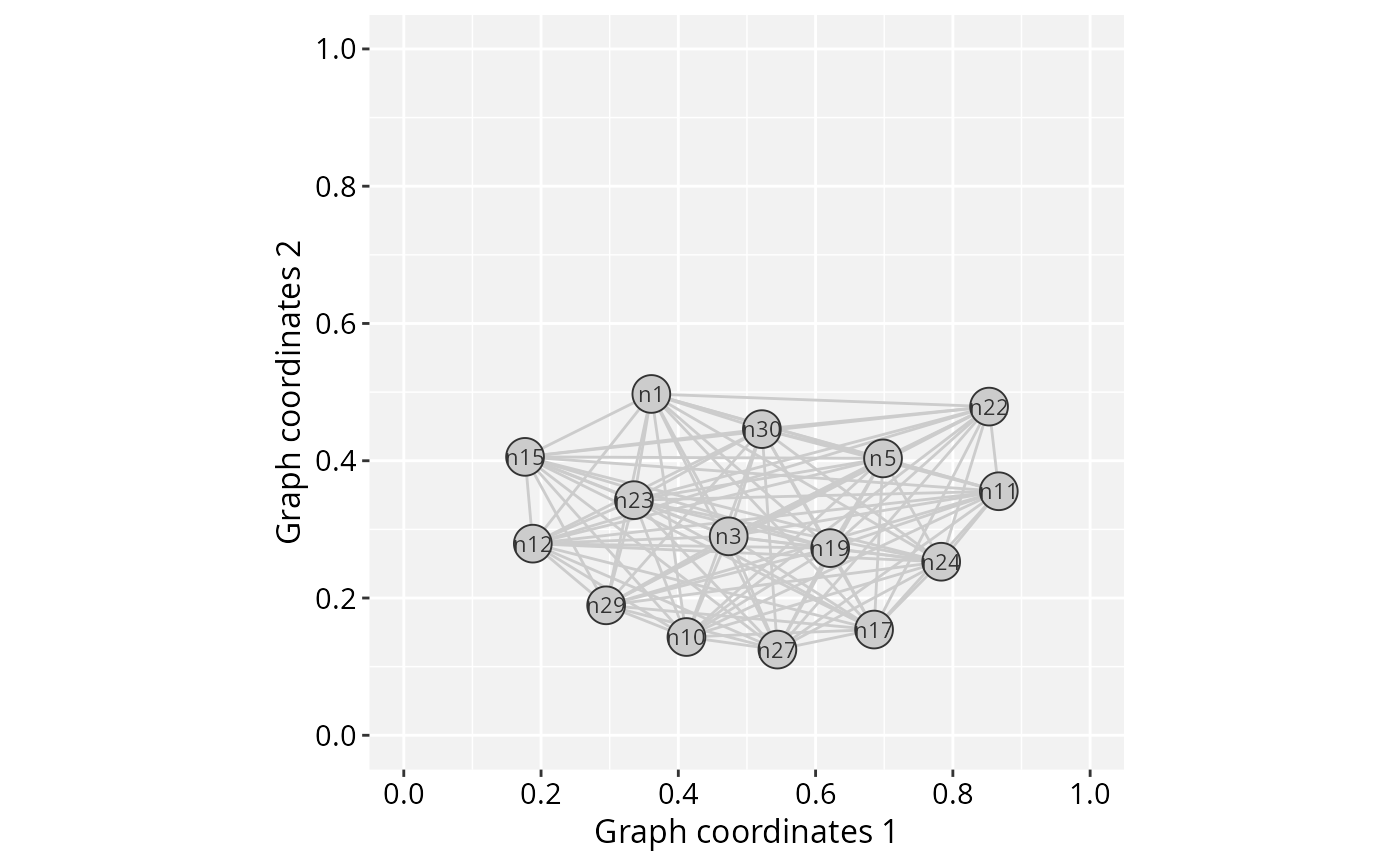
cropGraphSpace() subsets a normalized graph space to a specific
region defined by the cropping boundaries. It recalculates node positions
and background image boundaries to maintain spatial consistency after
cropping, and drops nodes (and edges) that fall outside the window.
rotateGraphSpace(), flipGraphSpace(), and
transposeGraphSpace() are all exact, a coordinate/pixel
permutation, with no resampling, no interpolation, and no risk of
misaligning nodes against the background image.
rotateGraphSpace() is restricted to a single 90-degree turn: apply
it again to its own output for 180 or 270 degrees. Combine all three with
each other to reach any of the 8 symmetries of a square.
Examples
library(RGraphSpace)
library(igraph)
# Create a star graph
gtoy1 <- make_full_graph(30)
# Create a GraphSpace
gs <- GraphSpace(gtoy1)
#> Validating the 'igraph' object...
#> Vertex attributes 'x' and 'y' missing; computing layout...
#> Vertex attribute 'name' missing; assigning names...
#> Ignoring graph-level attributes: 'name', 'loops'
#> Creating a 'GraphSpace' object...
gs <- normalizeGraphSpace(gs)
#> Normalizing node coordinates to graph space...
gs_crop <- cropGraphSpace(gs, ymax = 0.5)
#> Cropping graph space to x in [0, 1], y in [0, 0.5]...
gs_rot90 <- rotateGraphSpace(gs)
#> Rotating normalized coordinates 90 degrees clockwise...
gs_flip <- flipGraphSpace(gs)
#> Flipping normalized coordinates vertically...
gs_t <- transposeGraphSpace(gs)
#> Transposing normalized coordinates...
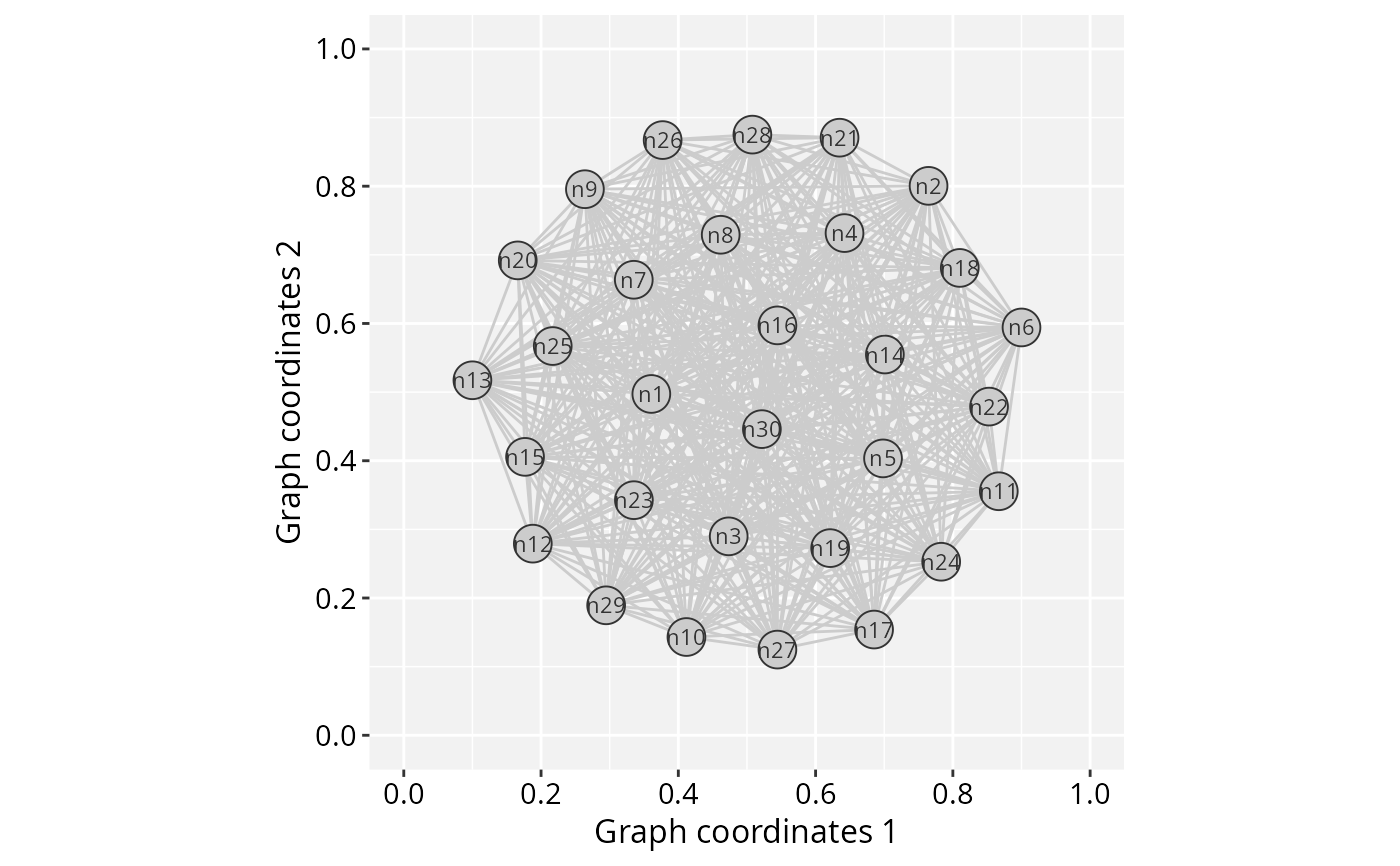
plotGraphSpace(gs, node.labels = TRUE)
 plotGraphSpace(gs_crop, node.labels = TRUE)