Normalize node coordinates to graph and image spaces
Source:R/gspace-normalize.R
normalizeGraphSpace-methods.RdAccessory function to normalize node coordinates of a GraphSpace object, either by centering nodes within the plot boundaries or by mapping nodes to pixel coordinates of a background image.
Usage
# S4 method for class 'GraphSpace'
normalizeGraphSpace(
  gs,
  mar = 0.1,
  image.space = .has_image(gs),
  flip.x = FALSE,
  flip.y = image.space,
  flip.v = FALSE,
  flip.h = FALSE,
  swap.xy = FALSE,
  equal.mar = FALSE,
  norm.geometry = FALSE,
  verbose = TRUE
)
Arguments
- gs
A
GraphSpaceobject to be normalized.- mar
A single numeric value in
[0, 0.5]setting the margins around the graph, as a fraction of the final normalized space. For example,mar = 0.1leaves a margin of 0.1 on each side, so the graph occupies the central 0.8 of the space. With an image, the image is cropped to the same proportions; if the graph lies close to an image border, the crop is shifted or truncated to stay within the image, and the requested margin may not be reached.- image.space
Logical; if an image is available, whether to use it as a background reference map. When enabled,
xandygraph coordinates are interpreted as pixel coordinates in the image matrix. Images can be inspected and assigned withgs_image.- flip.x
Logical; whether to flip the node coordinates along the x-axis.
- flip.y
Logical; whether to flip the node coordinates along the y-axis. Useful for aligning nodes with image backgrounds, which often use an inverted coordinate system. Defaults to
image.space.- flip.v
Logical; whether to vertically flip the background image matrix (top-to-bottom) to align with the graph coordinate system.
- flip.h
Logical; whether to horizontally flip the background image matrix (left-to-right) to align with the graph coordinate system.
- swap.xy
Logical; whether to swap x and y node coordinates. Useful when the graph coordinate system is transposed relative to the image or reference map.
- equal.mar
Logical; when an image is available, whether to fit the image with equal margins around the graph, resulting in a tighter crop of the image. If FALSE (default), the image is fitted to the full square figure area, resulting in unequal margins when the graph aspect ratio differs from 1. Both methods preserve the aspect ratios of the image and graph.
- norm.geometry
Logical; when geometries are available, whether to normalize them. If
TRUE, normalizeGeometry is called at the end of the normalization process.- verbose
A single logical value specifying to display detailed messages (when
verbose=TRUE) or not (whenverbose=FALSE).
Details
This function re-scales node coordinates to a [0, 1] unit square
based on the graph's bounding box when image.space = FALSE or, when
an image is provided and image.space = TRUE, it maps nodes to pixel
coordinates. It handles image-to-graph alignment via flip.\* and
swap.\* arguments, used to adjust the graph origin with the image
matrix layout. Users should be aware of the potential discrepancy between
image matrix orientation (top-down) and graph coordinates (bottom-up). The
function attempts to automatically adjust the y-axis to align the graph's
bottom-up coordinates with the image's top-down layout, but further manual
adjustments might be required.
Note
This is an accessory function typically called during
the preprocessing of GraphSpace objects before rendering.
Examples
library(RGraphSpace)
library(igraph)

# Create a star graph
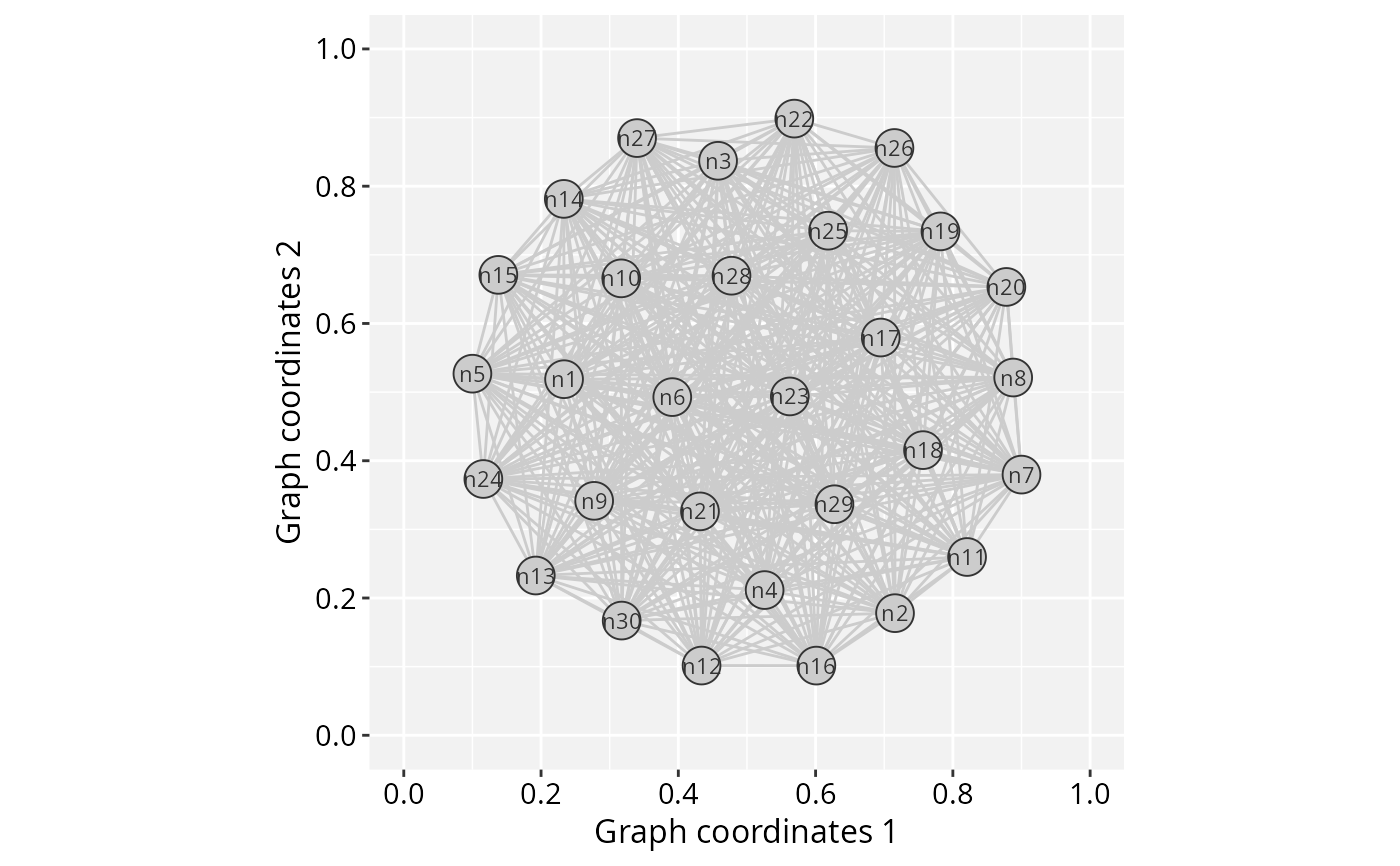
gtoy1 <- make_full_graph(30)

# Create a GraphSpace
gs <- GraphSpace(gtoy1)
#> Validating the 'igraph' object...
#> Vertex attributes 'x' and 'y' missing; computing layout...
#> Vertex attribute 'name' missing; assigning names...
#> Ignoring graph-level attributes: 'name', 'loops'
#> Creating a 'GraphSpace' object...

gs <- normalizeGraphSpace(gs)
#> Normalizing node coordinates to graph space...

plotGraphSpace(gs, node.labels = TRUE)