Constructor for GeomNodeSpace ggproto objects.
A wrapper around geom_point that bridges GraphSpace node attributes with ggplot2 rendering via two distinct aesthetic interfaces that coexist without collision (see Two aesthetic interfaces section).
Usage
geom_nodespace(
  mapping = NULL,
  data = NULL,
  stat = StatNodeSpace,
  position = "identity",
  ...,
  na.rm = FALSE,
  show.legend = NA,
  inherit.aes = FALSE,
  raster = FALSE,
  dpi = NULL,
  dev = "cairo",
  scale = 1
)

nodespace_handler(mapping = NULL)
Arguments
- mapping
Set of aesthetic mappings created by
ggplot2::aes(). These mappings override global aesthetics and are not inherited from the top-level plot.- data
The data to be displayed in this layer. It can be a GraphSpace object, an igraph object, or the
nodespace_handler()closure. WhenNULL(default), a handler is created internally from themappingargument.- stat
The statistical transformation to use on the data. Defaults to
identity.- position
Position adjustment, either as a string or the result of a call to a position adjustment function.
- ...
Additional parameters passed to the underlying drawing function in GeomNodeSpace.
- na.rm
Logical. Should missing values be removed? Defaults to
FALSE.- show.legend
Logical or a named logical vector indicating whether this layer should be included in legends.
- inherit.aes
Logical. If
FALSE(default), the layer will use aesthetics defined inmapping.- raster
Logical. Should node glyphs be rasterized? Rasterization support is based on
rasterise.- dpi
Numeric. Rasterization resolution.
- dev
Character. Rasterization backend. One of
'cairo','ragg','ragg_png', or'cairo_png'.- scale
Numeric. Rasterization scaling factor (see
rasterise).
Value
A ggplot2 layer that renders node glyphs defined by GeomNodeSpace.
Details
The interpretation of size depends on how it is provided:
As an aesthetic: When mapped within
aes(),sizefollows the behavior of geom_point, using absolute units to ensure consistency with the plot legends.As a parameter: When set outside
aes(),sizeis treated as a percentage of the viewport ([0, 100]), scaling innpcunits. This allows nodes to resize dynamically with viewport changes.
Aesthetics
geom_nodespace() understands geom_point aesthetics.
If these aesthetics are not explicitly provided in aes(), they
are automatically retrieved from the GraphSpace object.
x, y | Node coordinates (required; automatically supplied). |
fill | Node interior colour (see aes_colour_fill_alpha). |
colour | Node border colour (see aes_colour_fill_alpha). |
alpha | Transparency (see aes_colour_fill_alpha). |
shape | Node shape (see points and aes_linetype_size_shape). |
size | Node size (see drawing section and aes_linetype_size_shape). |
stroke | Node line width (see gg_par and aes_linetype_size_shape). |
Required aesthetics are supplied from the GraphSpace object and do not need to be manually mapped.
Fixed identity values can also be passed directly as parameters, bypassing
both graph attributes and scale training.
For example: fill = "red", stroke = 3, alpha = 0.5, or shape = 21.
Two aesthetic interfaces
geom_nodespace() supports two interfaces that coexist without
collision: graph attributes (camelCase names such as nodeColor,
nodeSize) and ggplot2 mappings (via aes()). See comments in
the vignette.
When multiple sources provide the same aesthetic, priority follows:
aes() mapping > fixed parameter > graph attribute.
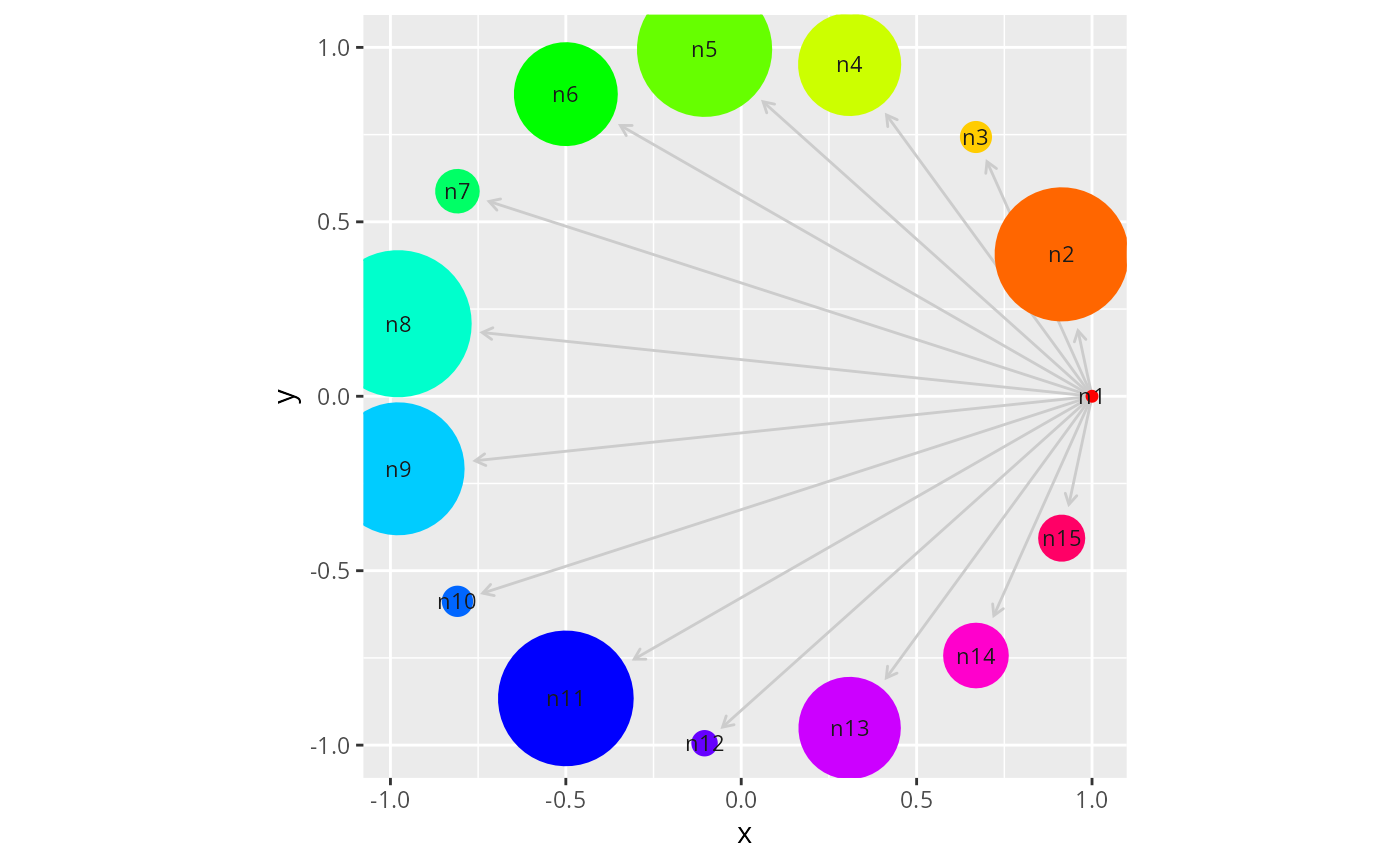
Label aesthetics
When label is mapped via aes(), a text label is drawn at
each node's position using geom_text, rendered on
top of the node glyph. Nodes with NA labels are silently skipped.
The label_size and label_colour aesthetics are automatically
retrieved from the GraphSpace object when not explicitly provided
in aes(). All other label_* aesthetics default to
geom_text when not set.
label | Required to activate label rendering. |
label_size | Font size
(see geom_text). |
label_colour | Label colour
(see geom_text). |
label_alpha | Label transparency
(see geom_text). |
label_angle | Rotation angle
(see geom_text). |
label_hjust | Horizontal justification
(see geom_text). |
label_vjust | Vertical justification
(see geom_text). |
label_family | Font family
(see geom_text). |
label_fontface | Font face
(see geom_text). |
label_lineheight | Line height
(see geom_text). |
Examples
library(RGraphSpace)
library(igraph)
library(ggplot2)
# Make a demo igraph
gtoy1 <- make_star(15, mode="out")
# Set some node attributes
V(gtoy1)$nodeSize <- runif(vcount(gtoy1), 1, 20)
V(gtoy1)$nodeColor <- rainbow(vcount(gtoy1))
# Set some variables
V(gtoy1)$user_var1 <- runif(vcount(gtoy1), 1, 3)^3
V(gtoy1)$user_var2 <- rep(c(1, 2, 3), each = 5)
# Create a GraphSpace object
gs <- GraphSpace(gtoy1, layout = layout_in_circle(gtoy1))
#> Validating the 'igraph' object...
#> Vertex attribute 'name' missing; assigning names...
#> Ignoring graph-level attributes: 'name', 'mode', 'center'
#> Creating a 'GraphSpace' object...
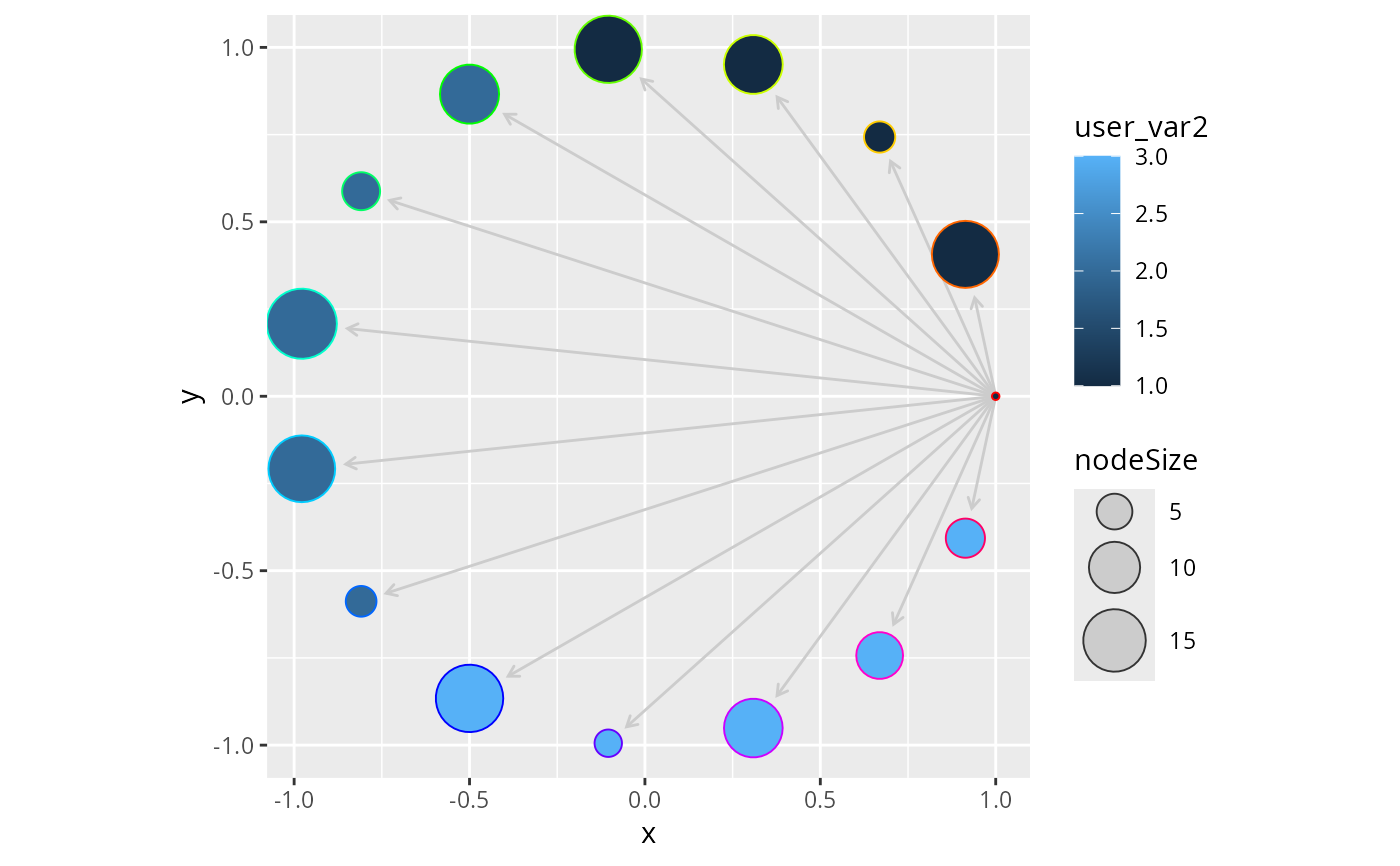
# Example 1: Nodes scaling with the legend
# When 'size' is mapped inside aes(), it follows
# ggplot2 default behavior: size is translated
# to absolute units (mm) via 'scale_size()'.
ggplot(gs) +
geom_edgespace(arrow_offset = 0.01) +
geom_nodespace(mapping = aes(size = nodeSize, fill = user_var2)) +
scale_size(range = c(1, 12)) +
theme(aspect.ratio = 1)
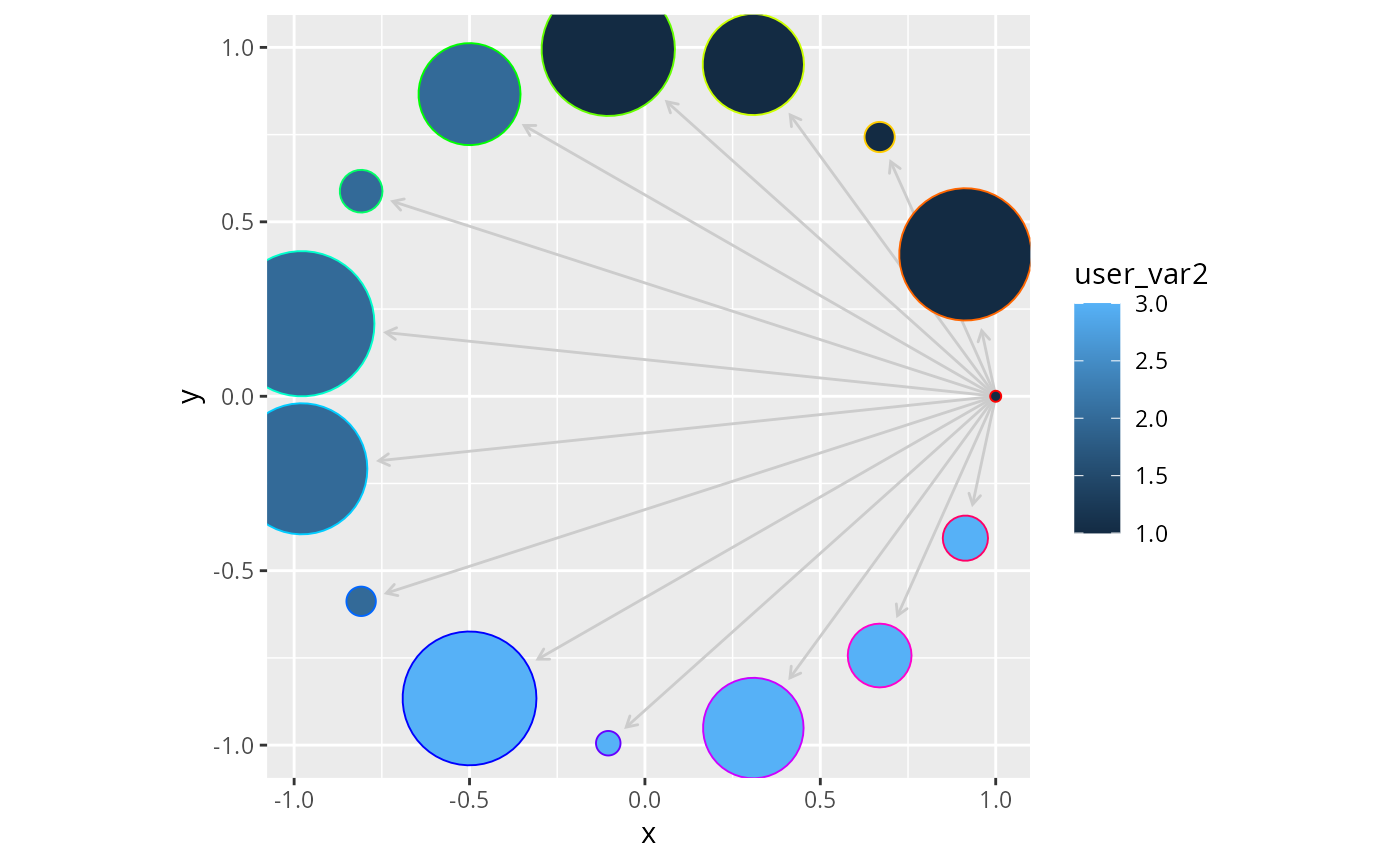
 # Example 2: Nodes scaling with the viewport
# When 'size' is passed as a node attribute,
# inherited from the igraph object, it is
# interpreted as a percentage of the plotting
# area and translated to NPC units.
ggplot(gs) +
geom_edgespace(arrow_offset = 0.01) +
geom_nodespace(mapping = aes(fill = user_var2)) +
theme(aspect.ratio = 1)
# Example 2: Nodes scaling with the viewport
# When 'size' is passed as a node attribute,
# inherited from the igraph object, it is
# interpreted as a percentage of the plotting
# area and translated to NPC units.
ggplot(gs) +
geom_edgespace(arrow_offset = 0.01) +
geom_nodespace(mapping = aes(fill = user_var2)) +
theme(aspect.ratio = 1)
 # Example 3: Node labels
ggplot(gs) +
geom_edgespace() +
geom_nodespace(aes(label = nodeLabel)) +
theme(aspect.ratio = 1)
# Example 3: Node labels
ggplot(gs) +
geom_edgespace() +
geom_nodespace(aes(label = nodeLabel)) +
theme(aspect.ratio = 1)